Subtotal ₹0.00
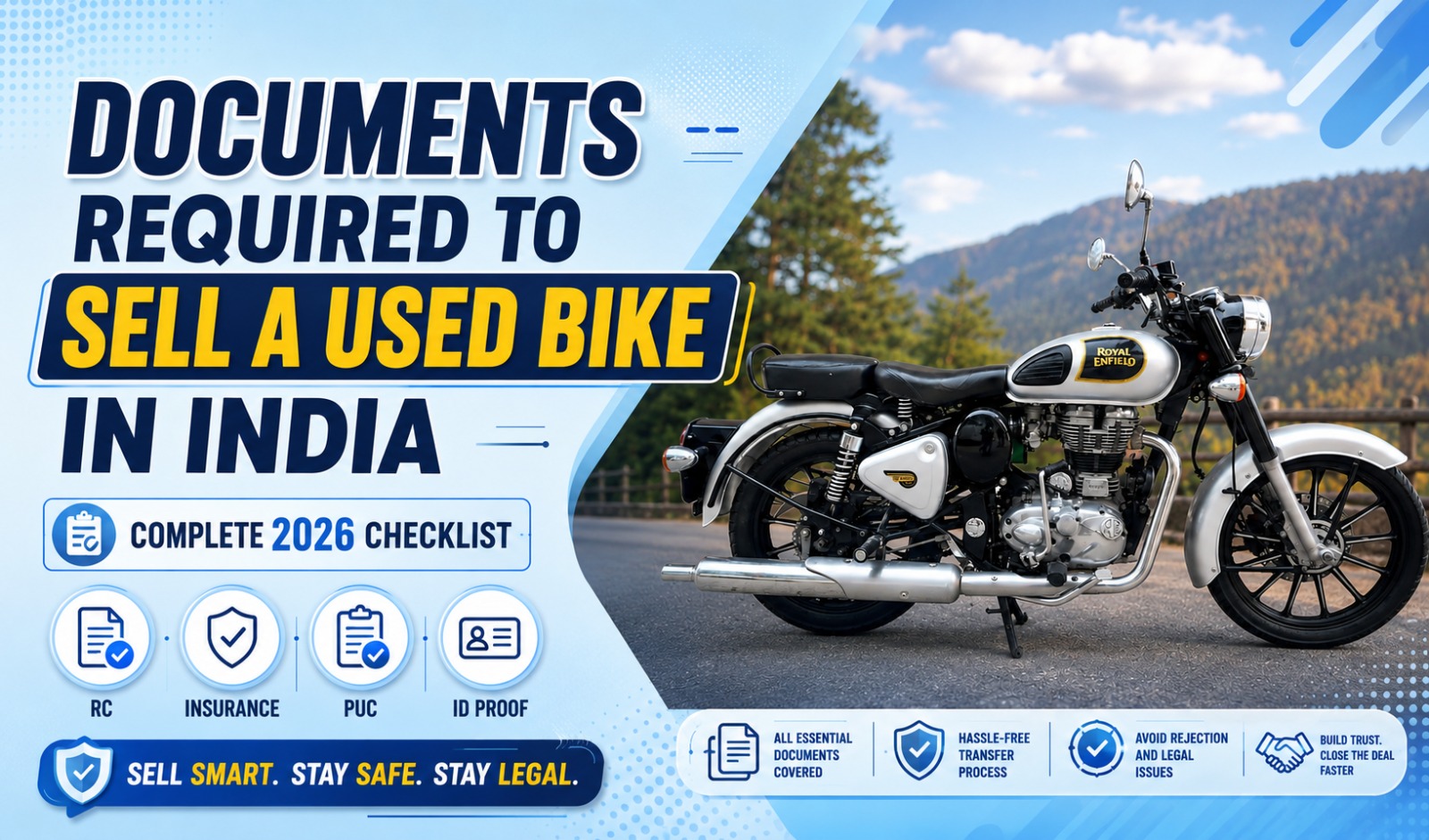
So you’ve decided to sell your bike. Maybe you’re upgrading, maybe it’s been gathering dust for a while, or maybe you’ve finally made the switch to four wheels. Whatever brought you here, before you can actually hand over the keys and pocket the cash, there’s one thing that tends to trip people up: the paperwork.
Here’s something most sellers don’t realize until it’s too late — you rarely lose a buyer over price or condition. You lose them because the moment they’re ready to pay, you’re not ready with the documents. A serious buyer wants to move fast, and if you’re suddenly digging through drawers for your RC or realizing your PUC expired three months ago, that window shuts quietly and quickly.
So let’s avoid that. Here’s everything you actually need, why each one matters, and a few things people commonly forget until the very last minute.
1. Registration Certificate (RC)
This is, without question, the most important document in the whole process. Your RC is the legal proof that the bike is actually yours to sell — without it, no buyer is going to take you seriously, and no RTO is going to process the transfer. If yours is damaged, missing, or you’re still holding the old paper version instead of the smart card, get a duplicate sorted at your local RTO before you even start talking to buyers. It’s not a same-day process, so build that time in.
2. Valid Insurance
Your bike needs to be insured at the time of sale, even if it’s just a basic third-party policy. Buyers will ask for this, and they should — riding without valid insurance is illegal in India, and it can hold up the transfer too. If yours has lapsed, just renew it before you list the bike. Nothing kills a buyer’s confidence faster mid-conversation than finding out the insurance ran out months ago.
3. Pollution Under Control (PUC) Certificate
This one’s mandatory, and honestly, it’s the easiest fix on this entire list — a quick visit to any authorized testing center and a small fee gets it renewed. But don’t skip it. An expired PUC makes a buyer wonder what else you might have let slide, even if the bike itself is in great shape.
4. Original Sale Invoice
The invoice from when you first bought the bike helps establish the chain of ownership, and the RTO often asks for it during the transfer. Dig it out and keep it with your other bike documents — not buried somewhere in an old email you’ll never find again.
5. Form 28, 29, and 30
These three forms are what actually make the ownership transfer official:
- Form 28 — a No Objection Certificate, needed only if you’re selling to someone registered in a different state
- Form 29 — notifies the RTO that ownership is changing hands
- Form 30 — the actual application for transfer of ownership
Most buyers and RTO staff will walk you through these anyway, but having them ready in advance saves a lot of back and forth — and honestly, it makes you look like a seller who has their act together.
6. Valid ID Proof
Your Aadhaar card, PAN card, or any government ID that matches the name on the RC. This is standard during the transfer process and confirms, simply, that you are who the paperwork says you are.
7. No Objection Certificate (NOC) from the Financier
Took a loan to buy the bike? Then you’ll need an NOC from your bank or financing company stating that the loan is fully paid off and they have no further claim on it. Without this, the RC transfer just won’t happen, no matter how eager the buyer is. Banks can take a few working days to issue it, so it’s worth requesting this the moment you decide to sell, not the moment you find a buyer.
Good to Have, Not Always Mandatory
None of these are legally required, but they make the whole process smoother — and sometimes, they’re the difference between a buyer hesitating and a buyer saying yes.
| Document | Why it helps |
|---|---|
| Service history records | Builds buyer trust and can help justify your asking price |
| Duplicate keys | Buyers expect at least two sets at handover |
| Road tax payment receipt | Particularly relevant if you’re selling across state lines |
A Quick Reality Check
Here’s the part nobody tells you upfront: even with every single document sorted, finding a genuine buyer who’ll pay a fair price is a whole separate battle. Most sellers end up fielding low-ball offers, dealing with people who go silent after one message, or waiting weeks for someone who was never really going to buy. Paperwork is only half the job.
That’s the gap Winloo exists to close. Instead of posting your bike and hoping the right person scrolls past it, Winloo puts you directly in touch with verified buyers who are already looking for a bike like yours. So once your documents are in order, you’re not stuck chasing dead-end leads — you’re talking to someone who’s actually ready to buy.
Ready to sell your bike without the back-and-forth?
Get connected with verified buyers on Winloo today.
Common Questions
At the very least, you'll need your RC, valid insurance, a current PUC certificate, the original sale invoice, Form 29 and Form 30 for the ownership transfer, and a valid ID. If there was a loan on the bike, add an NOC from your bank to that list.
Not really, no. The RC is the one document you can't work around — it's your proof of ownership. If you've lost it, head to your local RTO and apply for a duplicate before you start showing the bike to buyers, since it usually takes a couple of weeks to come through.
Only if your buyer is registered in a different state from you. Form 28 is essentially a No Objection Certificate for that inter-state move. If you're both in the same state, you can skip it entirely.
Just renew it before you go ahead with the sale. Buyers almost always ask to see proof of valid insurance, and you'll generally need an active policy for the RTO transfer to go smoothly anyway.
Once your loan is fully paid off, reach out to your bank or financier directly and ask for the NOC. It confirms they have no remaining claim on the bike. It usually takes a few working days, so request it as soon as you've decided to sell rather than waiting until a buyer's ready.
It's not a legal requirement, but it's genuinely worth having. A clean service history reassures buyers that the bike's been looked after, and it can help you justify a better asking price.
Used BikesSelling GuideRC TransferIndia


Comments are closed